- Appointments
- Locations
- Services
Hospital Services
Care for the Family
Specialty Care
Community Health
- For Patients
Billing & Insurance
Your Visit
Resources
Classes, Events & News
Medical Records
- Careers
- Appointments
- Locations
- Services
Hospital Services
Care for the Family
Specialty Care
Community Health
- For Patients
Billing & Insurance
Your Visit
Resources
Classes, Events & News
Medical Records
- Careers
Championing a Healthier West End
Services
Get Care Now
Care for the Family
Specialty Care
Community Health
Championing a Healthier West End
For Patients
Billing & Insurance
Your Visit
Resources
Classes, Events & News
Medical Records
Championing a Healthier West End

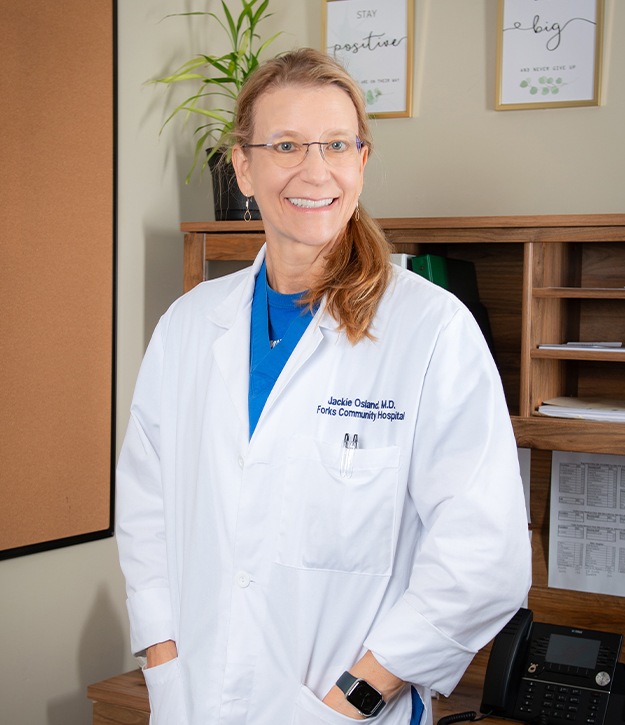
Dr. Jacqueline Osland on Colon Cancer Screening Guidelines
- Home
- Forks News
- Ask the Expert
- Dr. Jacqueline Osland on Colon Cancer Screening Guidelines
Ask the Expert
Dr. Jacqueline Osland on Colon Cancer Screening Guidelines

What are the new guidelines for colorectal cancer screening, and is screening necessary if there are no symptoms?
Over the last decade, researchers found an increase in the number of young patients diagnosed with colorectal cancer, and often, with a more advanced stage of the disease. As a result of this trend in the wrong direction, in 2021, the U.S. Preventive Services Task Force lowered the age of colorectal cancer screening from 50 to 45 years of age, believing that doing so would help lower the risk of death from colorectal cancer in this younger age group. For example, on average, the five-year survival rate for colorectal cancer in early stages is above 90%. The change in screening guidelines has led to a significant increase in early-stage diagnosis among those in the 45-49 years old range, and that is good news.
On the question about whether screening is necessary for everyone starting at age 45, when there are no symptoms, the answer is yes. Indeed, that is the very definition of screening, which is testing done when there are no symptoms.
There are some special groups of patients to which screening may occur before age 45 years of age. For example, patients with a family history of colon cancer affecting family members at a young age, of patients with a personal history of inflammatory bowel disease such as ulcerative colitis or Crohn’s disease.
Others in the higher risk category are Black Americans and Native Americans as research shows they experience disproportionately higher rates of colon cancer incidence and mortality compared to other racial and ethnic groups. In addition, there are other known risks, such as being overweight and smoking, and for this reason, it’s important to talk with your doctor or healthcare professional, because they will be able to factor in your full health history and provide you with a recommendation for screening.
Screening for colon cancer detects pre-cancerous growths called polyps in the colon. Removal of these polyps during the colonoscopy removes the opportunity for that polyp to grow into a colon cancer. One other point on the importance of following screening guidelines is that colon polyps don’t usually cause symptoms, and that is why it is so important to find them and remove them early.
Common Signs & Symptoms of Colorectal Cancer
When an individual, regardless of age, is experiencing any signs or symptoms of colorectal cancer it is extremely important to tell your doctor immediately so that they can evaluate you and determine the best course of action, which may be to have a colonoscopy for diagnostic purposes. The common signs and symptoms of colorectal cancer include:
Blood noted in the stool or a change in stool color to a dark, black color
Change in bowel habits, such as diarrhea, constipation, or narrowing of the stool, that lasts for more than a few days
Feeling a need to have a bowel movement that’s not relieved by having one
Cramping or abdominal pain
Weakness and fatigue
Unintended weight loss
Screening Options
Now I’ll talk about screening options, because oftentimes, individuals avoid colorectal cancer screening due to fears about what it entails. There are two main types of tools used for colorectal cancer screening, and they include: stool-based tests and the other is a visual exam, known as colonoscopy.
- Stool-based tests: This is a non-invasive test that checks the stool for abnormalities such as abnormal DNA or blood.
- Visual exams (colonoscopy): A procedure under sedation performed by a gastroenterologist or a surgeon. During a colonoscopy a tube-like instrument with a light and tiny video camera is inserted into the rectum (the end of the large intestine just inside the anus) and passed around the length of the colon. The purpose is to identify any abnormal areas or polyps inside the colon or rectum. If a polyp is found, the surgeon removes it and sends it to the lab for analysis. For this procedure patients must do a full bowel prep, and they do need someone to drive them home after the procedure.
Undergoing appropriate colon cancer screening, understating your risk factors, and being alert to the signs of colon cancer can help reduce your risk of colorectal cancer.
Lastly, don’t hold back your questions about colorectal cancer screening, signs or symptoms. As referenced above, the earlier it is diagnosed the higher the survival rate, in general.
Thankfully, for individuals 45 or older, Forks Community Hospital does provide colorectal cancer screening services, including colonoscopy and stool testing. Reach out to us if you’d like to learn more or to schedule a consultation.
For more information about colorectal cancer screening, risk factors, prevention and more, the American Cancer Society is a reliable source.